
Lee County Sheriff Arrest Search gives you instant access to real-time booking records for people processed at the Main Jail in Fort Myers, Florida. This public tool shows arrest dates, booking numbers, and charges filed at intake—but never reflects final court outcomes like convictions or dismissals. Always check the Lee County Clerk of Courts docket at www.leeclerk.org for verified case results, which update every night. If someone needs a record removed from public view, the sheriff’s website offers a direct form to start that official process.
How the Lee County Sheriff Arrest Search Works
The online booking search pulls data directly from the Lee County Sheriff’s Office jail management system. Each entry includes the person’s full name, booking photo (mugshot), date of birth, arrest date, booking number, housing location, and all charges listed at the time of intake. The system refreshes multiple times daily, so information is current within hours of processing. However, it only shows what happened when someone was booked—not what happened later in court. Charges may be dropped, reduced, or changed before trial. That’s why users must cross-check with the Clerk of Courts for final dispositions.
To use the search, go to the official portal and enter a name, booking number, or date range. Results appear instantly with filters for active inmates, recent releases, or specific offenses. The interface is simple: no login required, no fees, and no registration. It’s designed for transparency, letting families, lawyers, journalists, and researchers track arrests quickly and accurately.
Official Lee County Sheriff Booking Search Portal
The main entry point for Lee County Sheriff Arrest Search is the dedicated booking database hosted on the sheriff’s official site. This secure, government-run page ensures data integrity and compliance with Florida public records laws. It clearly states that all individuals are presumed innocent until proven guilty in court. The site also warns against using this information for employment, housing, or credit decisions without verifying final case status.
Alongside the search tool, the portal provides key disclaimers: arrest records do not imply guilt, charges may be amended, and only the courts determine legal outcomes. A prominent “Click Here” link guides users who want to request record removal—typically used when charges were dismissed, expunged, or sealed under Florida Statute 943.059. This form starts an internal review by the Records Division, which coordinates with the State Attorney’s Office and Clerk of Courts before any removal.

Understanding Arrest vs. Conviction in Lee County
Many people confuse arrest records with criminal convictions—but they’re not the same. An arrest happens when law enforcement takes someone into custody based on probable cause. A conviction only occurs after a judge or jury finds guilt beyond a reasonable doubt. In Lee County, over 60% of felony arrests don’t result in conviction due to dropped charges, plea deals, or acquittals. That’s why the sheriff’s booking search explicitly says it doesn’t show final case outcomes.
For example, someone arrested for burglary might have charges reduced to trespassing—or dismissed entirely if evidence is weak. The booking record will still list the original charge unless manually updated, which rarely happens automatically. Always verify with the Lee County Clerk of Courts docket, where judges enter sentencing details, plea agreements, and dismissal orders nightly. This separation protects civil rights and prevents misinformation.
Lee County Sheriff Online Search Portal Features
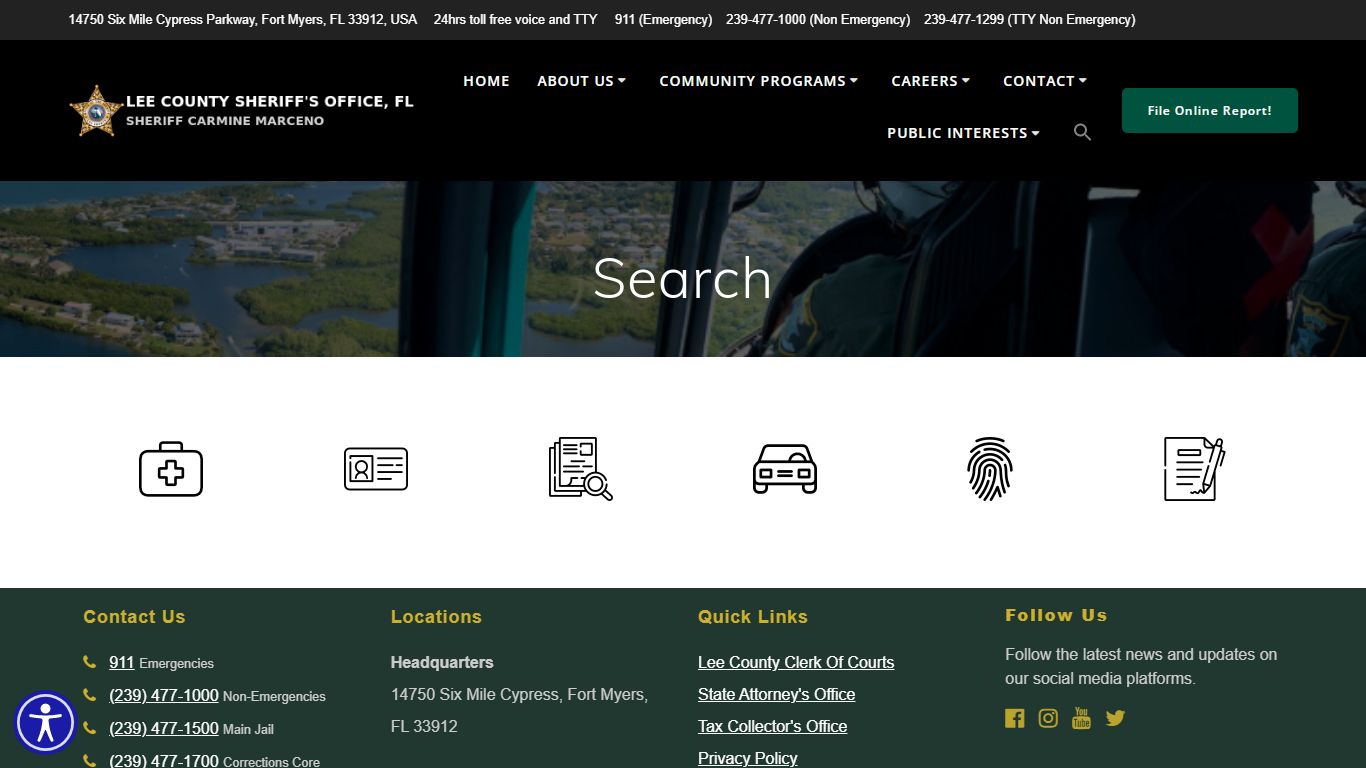
The broader Lee County Sheriff website includes more than just arrest searches. Its main search portal links to community programs, career opportunities, public interest requests, and contact directories. Quick navigation buttons lead to “Home,” “About Us,” “Community Programs,” “Careers,” and “Contact,” each with detailed subpages. The site clearly lists two key addresses: the Main Jail at 14750 Six Mile Cypress Parkway and the administrative headquarters at 2115 Martin Luther King Blvd, both in Fort Myers.
Visitors can submit public records requests online through a secure form that routes inquiries to the correct division. The system tracks submission status, fees, and estimated delivery times. Certified copies of arrest reports, incident summaries, and court filings are available for purchase, with payments processed electronically. All requests follow Florida’s Sunshine Law, ensuring timely responses within 10 business days unless exempted.
Lee County Sheriff Headquarters and Facility Locations
The central hub for Lee County Sheriff operations is the Main Jail complex at 14750 Six Mile Cypress Parkway, Fort Myers, FL 33912. This facility houses intake, housing units, medical services, and administrative offices. It operates 24/7 for emergency responses and inmate processing. A second location at 2115 Martin Luther King Blvd serves as the Records Division, Public Information Office, and Civilian Services Unit. This building handles walk-in requests, records releases, and community outreach during standard business hours.
Both sites offer visitor parking, ADA-compliant entrances, and clear signage. The official website provides interactive maps, driving directions, and real-time updates on facility access. Emergency calls go to 911; non-emergency inquiries use 239-477-1850. For records specifically, call 239-477-1350 between 8 am and 3 pm Monday through Friday. Staff assist with document requests, fee schedules, and procedural questions.
Recent Arrests and Crime Reports: Transparency in Action
The “Recent Arrests & Crime Reports” page offers daily logs of law enforcement activity across Lee County. Users filter entries by date, offense type (e.g., DUI, theft, assault), or arresting division—Uniformed Patrol, Investigations, or Administrative Services. Each report lists the officer’s badge number, suspect name, statutory citation (like Florida Statute 812.014 for theft), and brief incident description. This level of detail supports journalistic accuracy and public accountability.
Monthly PDF archives compile all reports for trend analysis, helping researchers spot patterns in crime rates, response times, or enforcement focus. These documents are freely downloadable and updated every 24 hours. While useful for media and policy work, they’re not substitutes for official court records. Always confirm individual cases through the Clerk of Courts to avoid misrepresentation.
Lee County Arrests and Inmate Information: Third-Party Aggregators
Several external sites aggregate Lee County arrest data, such as florida.arrests.org. These portals pull mugshots, names, and charges from sheriff and clerk databases but come with risks. They often lack disclaimers about presumption of innocence, may display outdated info, and sometimes charge fees for “removal” services that aren’t officially sanctioned. Lee County Sheriff’s Office does not endorse or control these sites.
The official stance: always treat third-party data as supplemental. Verify every detail through sheriffleefl.org or leeclerk.org before making decisions. Florida law allows expungement of certain records, but only government agencies can legally remove them from public view. Private sites may ignore court orders, keeping dismissed cases visible indefinitely. Rely on primary sources for accuracy and fairness.
Lee County Sheriff Records Division: Certified Documents & Requests
The Records Division, located at 14750 Ben C. Pratt Six-Mile Cypress Parkway, manages all official document releases. Open Monday–Friday, 8 am–3 pm, it issues certified copies of arrest reports, incident narratives, court filings, and release forms. Requests start online via a “Click Here” button that initiates an electronic workflow. Users upload ID, pay fees (typically $15–$25 per document), and receive tracking updates via email.
Processing takes 5–10 business days for standard requests. Rush services cost extra. All documents bear the sheriff’s seal and are admissible in court. The division also handles public records appeals if requests are denied. Staff ensure compliance with Florida Statutes 119 (Public Records) and 943 (Criminal History), balancing transparency with privacy rights.
Common Misconceptions About Lee County Arrest Searches
One major myth is that appearing in the booking search means someone is guilty. In reality, arrests are investigative steps, not judgments. Another misconception is that records disappear after acquittal—but they remain public unless formally expunged. Some believe mugshots can’t be published, but Florida allows their release as part of booking records. However, commercial use for profit (e.g., mugshot extortion sites) is illegal under Florida Statute 817.568.
Also, many assume the sheriff’s site shows all inmates—but it only lists those booked into the Main Jail. People arrested by city police (like Fort Myers PD) may be processed elsewhere and not appear until transferred. Always check jurisdiction specifics. Lastly, “removal” doesn’t mean deletion; it means restricting public access per court order, which takes weeks to process.
How to Request Removal of a Lee County Arrest Record
If your arrest didn’t lead to conviction, you may qualify for record sealing or expungement under Florida law. Start by visiting the Lee County Sheriff’s website and clicking the “Click Here” link for record removal requests. You’ll need your booking number, case number (from the Clerk of Courts), and proof of dismissal or acquittal. The Records Division reviews submissions and forwards valid requests to the State Attorney’s Office for approval.
Once approved, the Clerk of Courts updates the docket, and the sheriff removes the record from public view within 30 days. Note: this doesn’t erase the record entirely—law enforcement and certain employers can still access it if legally permitted. Full expungement requires a separate petition to the court, often with legal assistance. Fees apply, but waivers exist for low-income applicants.
Lee County Sheriff Arrest Search: Privacy, Ethics, and Public Trust
Publishing arrest records serves transparency but raises privacy concerns. The Lee County Sheriff’s Office follows strict guidelines: no names of minors, no details of ongoing investigations, and clear disclaimers about innocence. Mugshots are included because they’re part of the booking process, not to shame individuals. However, the office monitors misuse and cooperates with prosecutors against sites that exploit arrest photos for profit.
Community trust depends on balancing openness with fairness. That’s why the portal directs users to verify outcomes and offers removal pathways. It also provides victim resources, tip lines, and community programs—showing law enforcement as partners, not just enforcers. This approach aligns with Florida’s commitment to accountable, ethical policing.
Frequently Asked Questions About Lee County Sheriff Arrest Search
Lee County Sheriff Arrest Search is a vital tool for accessing public booking records, but users often have questions about its scope, accuracy, and limitations. Below are detailed answers to the most common inquiries, based on official policies, Florida statutes, and practical experience.
Can I find out if someone was convicted using the Lee County Sheriff Arrest Search?
No, the Lee County Sheriff Arrest Search only shows information from the time of arrest and booking. It does not include court outcomes like convictions, dismissals, or plea deals. To learn the final result of a case, you must check the Lee County Clerk of Courts docket at www.leeclerk.org. That site updates nightly with judge rulings, sentencing details, and case closures. Always verify legal status there before making decisions based on arrest data.
How often is the Lee County Sheriff booking database updated?
The booking database refreshes multiple times each day, usually within 2–4 hours of an inmate being processed. This ensures near real-time accuracy for arrests, housing locations, and charges listed at intake. However, changes made after booking—such as reduced charges or release on bond—may take longer to appear. For the most current status, call the Records Division at 239-477-1350 during business hours.
Why does the arrest search show charges that were later dropped?
The system records charges as they are filed at the moment of booking. Prosecutors or judges may drop, amend, or replace those charges later in court. The sheriff’s database isn’t automatically synced with court decisions, so outdated charges can remain visible. This is why Florida law requires users to consult the Clerk of Courts for final dispositions. Never assume guilt from an arrest record alone.
Can I get a certified copy of an arrest report from the Lee County Sheriff?
Yes, certified copies are available through the Records Division. Visit the official website, click the “Click Here” button for records requests, and submit your application online with valid ID and payment. Standard processing takes 5–10 business days. Certified reports include the sheriff’s seal and are legally admissible. Call 239-477-1350 for questions about fees or required documents.
What should I do if my arrest record appears but charges were dismissed?
First, obtain proof of dismissal from the Lee County Clerk of Courts. Then, use the “Click Here” removal request form on the sheriff’s website to start the official process. The Records Division will review your case and, if approved, coordinate with the State Attorney’s Office to restrict public access. Note that removal doesn’t erase the record—it limits who can see it. Full expungement requires a court order.
Are mugshots on the Lee County Sheriff site legal to share?
Mugshots are public records under Florida law and can be shared for non-commercial purposes. However, using them for profit—such as on mugshot removal websites—is illegal under Florida Statute 817.568. The sheriff’s office actively works with prosecutors to shut down sites that extort money for photo removal. Always respect privacy and avoid sharing images in ways that could harm someone’s reputation without cause.
Does the Lee County Sheriff Arrest Search include arrests by other agencies?
Only arrests processed at the Main Jail in Fort Myers appear in the search. If someone was arrested by a city police department (like Cape Coral PD or Bonita Springs PD) and not transferred to the county jail, they won’t show up. Check individual agency websites or the Clerk of Courts for complete records. The sheriff’s database is specific to county-operated facilities.
Official Website: https://www.sheriffleefl.org/booking-search/
Phone (Records): 239-477-1350
Phone (General): 239-477-1850
Visiting Hours (Records Division): Monday–Friday, 8:00 am – 3:00 pm
Main Jail Address: 14750 Six Mile Cypress Parkway, Fort Myers, FL 33912